

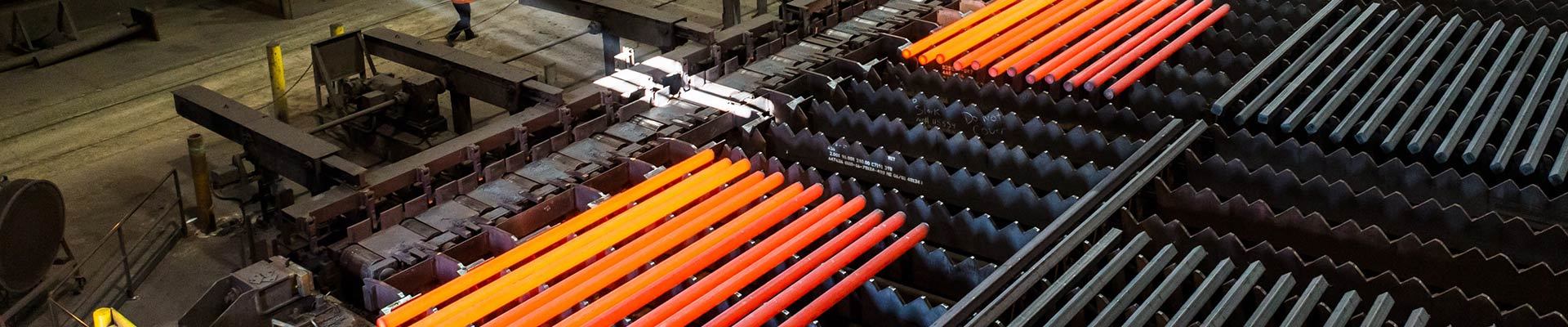
High-strength building "backbone": An introduction to HRB500 rebar and its applications
Release time:
2025-12-21
Deep within the steel jungle of modern construction, a material, with its exceptional strength and reliability, silently supports the "skeleton" of various major projects: HRB500 hot-rolled ribbed steel bars.
Definition and Characteristics: High-Performance Construction Steel Bars
HRB500 is a type of hot-rolled ribbed steel bar specified in my country's national standard (GB1499.2-2018), commonly known as Grade IV rebar. Its designation has a clear meaning: "H" represents hot-rolled, "R" represents ribbed, "B" represents rebar, and "500" indicates that its yield strength standard value is not less than 500 MPa. This means that a single HRB500 rebar can withstand a pressure of over 50 kg per square millimeter of cross-sectional area, a significant improvement in strength compared to traditional Grade III steel (HRB400).
In addition to high strength, HRB500 also possesses excellent comprehensive performance. Through optimized chemical composition design, it ensures strength while exhibiting good ductility, toughness, and weldability, meeting the processing requirements of complex engineering projects. Particularly noteworthy is its seismic-resistant model, HRB500E. Compared to the standard HRB500, it imposes even stricter requirements on seismic performance, exhibiting superior deformation capacity and energy absorption characteristics under extreme loads such as earthquakes, providing more robust seismic protection for buildings.
Advantages Analysis: Why Choose HRB500?
The selection of HRB500 rebar in large-scale engineering projects is primarily based on its dual advantages in engineering and economics:
Significantly Improved Structural Performance: Under the same design load, using HRB500 rebar can reduce steel consumption by approximately 30% compared to using HRB400 rebar. This not only directly reduces material costs but, more importantly, effectively solves the problem of excessively dense rebar at beam-column joints in high-rise buildings, making concrete pouring easier and more compact, thereby significantly improving the overall quality and durability of the structure.
Creating Long-Term Social Benefits: Promoting the use of high-strength rebar is an important measure for the country to achieve energy conservation, emission reduction, and sustainable development. It is estimated that widespread use of high-strength rebar such as HRB500 can reduce a significant amount of iron ore consumption and carbon dioxide emissions annually. From a building's entire lifecycle perspective, using high-strength steel reinforcement can effectively improve structural load-bearing capacity, helping to extend the building's safe service life.
Application Scenarios: A Standard Feature in Major National Projects
Thanks to its outstanding performance, HRB500 steel reinforcement is no longer a laboratory sample, but is widely used in various major national projects with extremely high requirements for safety and durability:
Infrastructure Challenges in Extreme Environments: In the construction of a high-altitude mining area in Tibet at 5000 meters above sea level, the special HRB500E steel reinforcement successfully withstood the extreme cold of -30℃. Its strong low-temperature toughness ensured stable performance under extreme climates, undertaking the main load-bearing reinforcement task in the mining area construction.
Key Support for Transportation Hubs: In the construction of the Zangke River Bridge, a key project of the Nayong-Qinglong Expressway in Guizhou Province, HRB500 and HRB500E steel reinforcement were precisely applied to the bridge's key structural parts, providing stable and reliable performance to safeguard the "steel skeleton" of this suspension bridge.
Landmark Buildings and Special Projects: Due to its high strength, HRB500 steel bars are particularly suitable for core vertical components of high-rise and super high-rise buildings, large frame structures, and pile foundations and main structures of long-span bridges. Furthermore, it has become an indispensable core building material in key national projects with extremely demanding material performance requirements, such as nuclear power plants and cross-sea bridges.
Conclusion: From the coast of the East China Sea to the snowy plateau, from skyscrapers in bustling cities to super bridges spanning natural barriers, HRB500 steel bars are building a solid foundation for China's modernization with their robust strength. Its widespread application is not only an upgrade in building materials but also a microcosm of China's manufacturing industry moving towards high-quality, green, and sustainable development.
WhatsApp:
Email:
Tel/WeChat
Office Address
15-10, Building J1, Wanda Plaza, 57 Gongye South Road, Jinan District, China (Shandong) Pilot Free Trade Zone